Subterranean termite treatment in Houston, TX demands specialized delivery systems due to the area's high annual rainfall and water tables that dilute topical retail sprays. Invasive Formosan subterranean termites…
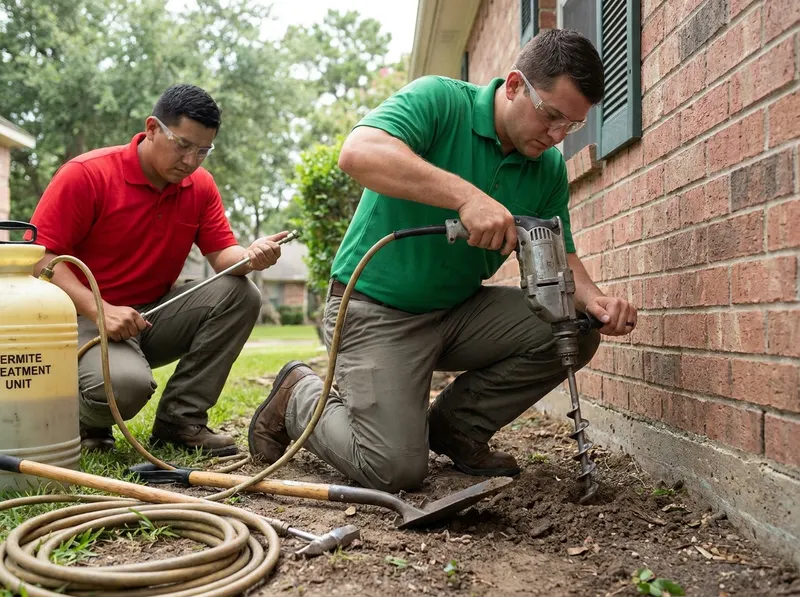
Subterranean termite treatment in Houston, TX demands specialized delivery systems due to the area's high annual rainfall and water tables that dilute topical retail sprays. Invasive Formosan subterranean termites consume up to 13 ounces of timber daily in a mature colony, requiring chemical barriers that transfer active ingredients directly back to hidden reproductive queens. Applying non-repellent liquid termiticides such as EPA-registered termiticides creates an undetectable zone around slab and pier-and-beam foundations. Rather than steering foragers away to untrenched expansion joints, workers ingest and carry fipronil formulations back to subterranean nests situated beneath expansive clays mapped by the NRCS Web Soil Survey. In historical pier-and-beam dwellings in Montrose and The Heights, treatments integrate sub-surface trenching around perimeter footings with specialized crawlspace wood-surface borate applications adhering to AWPA standards.
Selecting between continuous non-repellent liquid perimeters and subterranean baiting networks depends on foundation style, drainage gradients, and proximity to sensitive waterways like Buffalo Bayou. Slab foundations common in Meyerland, Spring Branch, and Memorial benefit from continuous trenching 6 inches wide by 6 inches deep, supplemented by pressure-injection through concrete patios every 12 inches to protect interior grade breaks. Properties situated near bayou corridors or high water tables in Clear Lake and Kingwood often utilize integrated baiting matrices meeting the structural integrity protocols of the U.S. Department of Housing and Urban Development. This approach reduces chemical runoff while providing passive structural monitoring across active termite flight windows cataloged by the Texas A&M AgriLife Extension. The trade-off between systems centers on latency versus immediate physical isolation: liquid non-repellents establish complete chemical protection along foundation margins within 30 to 90 days, whereas baiting systems require worker feeding cycles spanning several months to systematically collapse super-colonies.
All barrier applications are managed under commercial pesticide applicator rules enforced by the Texas Department of Agriculture to protect municipal watersheds. In dense developments throughout River Oaks and West University Place, heavy clay soils retain high moisture levels that accelerate structural wood rot when subterranean tunnels penetrate weep holes, as documented by USDA Forest Products Laboratory research. Technicians from TerraVance Bug Removal deploy precision flow meters calibrated to deliver 4 gallons of finished emulsion per 10 linear feet per foot of depth, strictly fulfilling regulatory label directions from the International Association of Certified Home Inspectors for wood-destroying insect clearances. Furthermore, treatment boundaries around landscaped zones and utility runs are mapped alongside Harris County environmental guidelines to prevent subterranean movement into adjoining timber framing.
Every job gets a firm, written price after a free on-site visit.
For standards, safe disposal, and service guidance on pest control services in Houston, TX, useful references include U.S. EPA, ENERGY STAR, U.S. Dept. of Energy, Consumer.gov, U.S. Census Bureau, and Google Maps. General consumer and small-business resources are available from USA.gov, Better Business Bureau, FTC Consumer Advice, U.S. Small Business Administration, and Ready.gov.
Tell us about your subterranean termite treatment job in Houston and we'll send a clear, written quote, usually the same day.
 TerraVance Bug Removal