Roof rat exclusion halts the lifecycle of Rattus rattus , a non-native commensal rodent adapted to Houston's humid, subtropical climate. Unlike ground-dwelling Norway rats, roof rats are agile climbers that travel…
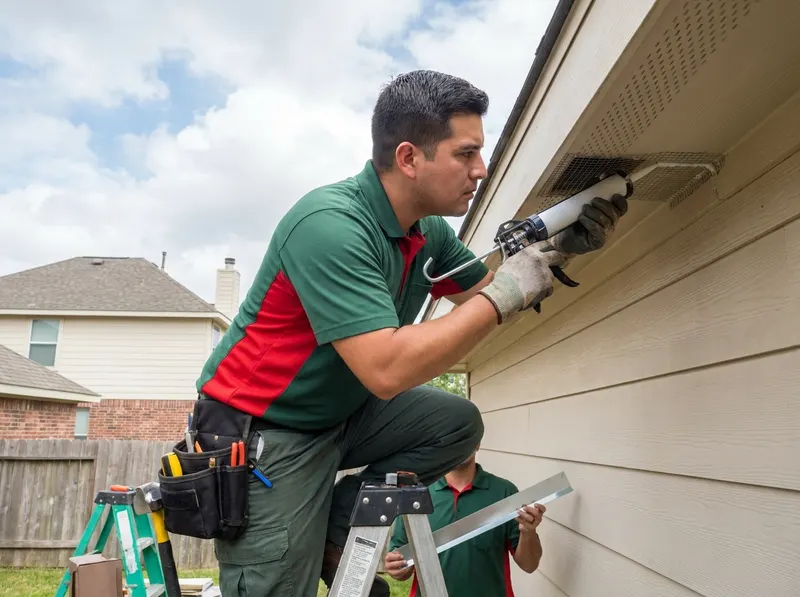
Roof rat exclusion halts the lifecycle of Rattus rattus, a non-native commensal rodent adapted to Houston's humid, subtropical climate. Unlike ground-dwelling Norway rats, roof rats are agile climbers that travel along live oak canopies, electrical service drops, and fence rails to breach high-elevation gaps in residential structures. Properties in mature neighborhoods like The Heights, Montrose, and River Oaks face intense roof rat pressure due to dense tree cover directly contacting architectural structures. A breach requires an opening of only 0.5 inches, the diameter of a standard quarter. Left unsealed, nesting activity ruins blown-in fiberglass insulation, soils ductwork with urine and droppings, and creates fire hazards when rodents strip thermoplastic insulation from copper wiring, an issue monitored under NFPA structural safety protocols.
Effective rodent defense demands structural permanence rather than chemical broadcast treatments. While store-bought retail rodenticides cause target animals to die inside concealed wall cavities, producing severe odor, fly breeding cycles, and secondary poisoning risks for non-target wildlife tracked by the Texas Parks and Wildlife Department, mechanical exclusion physically restores home envelopes. Technicians inspect high-vulnerability junctions including roof-wall returns, frieze boards, dormer tie-ins, plumbing vent stacks, and soffit vents across homes in Memorial and Spring Branch. Structural seals employ heavy-gauge 19-gauge galvanized 0.25-inch hardware cloth, non-corrosive metal flashing, and expanding elastomeric polyurethane foams compliant with ASTM building standards to resist chewing pressures exceeding 7,000 pounds per square inch.
Decision guidance hinges on current infestation staging versus preventative construction. If attic inspections reveal active droppings, greasy rub marks along rafters, or nocturnal gnawing noises, exclusion work must be combined with interior trapping using mechanical snap traps to eliminate trapped populations before exterior exits are sealed. If an adjoining property in Meyerland or West University Place experiences roof activity, preventative exclusion seals architectural openings before structural penetration occurs. Homes adjacent to waterways, such as Buffalo Bayou Park or drainage tributaries feeding Clear Lake, face continuous re-invasion pressure due to elevated humidity and dense riparian vegetation, making passive exterior bait boxes insufficient on their own.
Execution follows an objective, sequential protocol: First, technicians inspect roof eaves, chimney transitions, and crawlspaces from foundation to ridge lines. Second, technicians execute mechanical sealing of all structural apertures greater than 0.25 inches. Third, internal targeted snap trapping operates inside attics for 7 to 14 days under integrated vector principles outlined by the Centers for Disease Control and Prevention. Fourth, technicians re-inspect mechanical traps, retrieve captured rodents, and verify barrier integrity. Fifth, attic surfaces undergo sanitation with an EPA-registered antimicrobial disinfectant to neutralize pheromone trails and aerosolized pathogens, maintaining clean residential air quality standards in accordance with HUD healthy housing guidelines and consumer safety standards verified through the building envelope technical resources.
Every job gets a firm, written price after a free on-site visit.
For standards, safe disposal, and service guidance on pest control services in Houston, TX, useful references include U.S. EPA, ENERGY STAR, U.S. Dept. of Energy, Consumer.gov, U.S. Census Bureau, and Google Maps. General consumer and small-business resources are available from USA.gov, Better Business Bureau, FTC Consumer Advice, U.S. Small Business Administration, and Ready.gov.
Tell us about your roof rat exclusion job in Houston and we'll send a clear, written quote, usually the same day.
 TerraVance Bug Removal