Venomous spider management in Southeast Texas requires direct disruption of arachnid micro-habitats rather than standard broad-spectrum aerosol applications. The Texas A&M our team documents that brown…
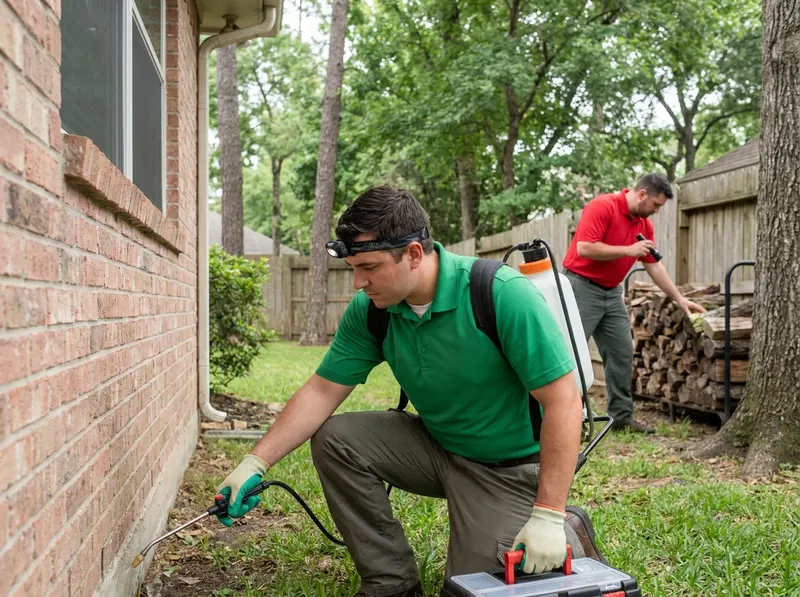
Venomous spider management in Southeast Texas requires direct disruption of arachnid micro-habitats rather than standard broad-spectrum aerosol applications. The Texas A&M AgriLife Extension documents that brown recluse spiders harbor inside dry, undisturbed voids such as attic insulation, cardboard storage boxes, and wall cavities, whereas southern black widows build irregular webs in low-elevation, dark recesses including weep holes, meter boxes, and garage corners. Retail surface sprays routinely fail against these species because spiders travel with their bodies elevated above treated planes, minimizing chemical uptake. Effective control relies on injecting desiccating micro-dusts into wall cavities, treating weep screeds, and applying micro-encapsulated formulations along foundation margins where EPA-registered pesticides adhere directly to rough brick and slab surfaces.
Sub-tropical moisture and soil dynamics across Harris County dictate distinct structural vulnerabilities. In older pier-and-beam properties throughout The Heights, Montrose, and West University Place, subfloor moisture attracts subterranean insects, creating an abundant protein source that sustains persistent black widow populations underneath floor joists. Conversely, slab-on-grade homes in Memorial, Spring Branch, and Meyerland frequently encounter brown recluse movements through expansion joints, plumbing chases, and soffit vents adjacent to dense oak canopies. TerraVance Bug Removal inspects structural breach points to determine whether an exterior perimeter defense suffices or if systematic interior mechanical disruption is required. Technicians evaluate crawlspaces and attics using protective suits compliant with NIOSH standards to safely isolate dense infestations.
Controlling prey species forms the scientific foundation for preventing secondary recolonization. Spiders settle exclusively where insect prey is accessible, meaning high cockroach and cricket counts accelerate arachnid reproduction. In forested suburban communities like Kingwood and The Woodlands, heavy leaf litter and pine straw retain dampness, encouraging wood roaches and earwigs against the perimeter. Managing exterior lighting compliant with the International Dark-Sky Association guidelines reduces nocturnal flying insects that draw widows toward entry doors. Concurrently, southern properties near Clear Lake and River Oaks face humidity surges documented by the National Weather Service Houston/Galveston office, driving arachnids inward toward climate-controlled wall voids. Physical exclusion work, guided by structural sealing principles from the U.S. Department of Energy, halts these migration pathways by sealing penetrations around electrical service lines and masonry ties.
Long-term containment demands disciplined maintenance of structural perimeters and storage hygiene. Storing goods in sealed polyethylene containers rather than corrugated cardboard strips brown recluses of preferred nesting substrates. Adhering to the OSHA respiratory protection protocols ensures safe applicator entry into confined residential attics during thermal fogging or dry dusting. Exterior foliage must remain pruned 12 inches away from fascia boards and foundation lines, as recommended by the International Society of Arboriculture, eliminating natural bridges that bypass exterior chemical barriers. For homes operating private water wells or adjacent to bayou systems, applicators observe buffer margins established by the Texas Commission on Environmental Quality to ensure chemical treatments do not interact with local aquatic habitats. Technicians confirm all localized environmental boundaries during the preliminary physical inspection before initiating chemical delivery.
Every job gets a firm, written price after a free on-site visit.
For standards, safe disposal, and service guidance on pest control services in Houston, TX, useful references include U.S. EPA, ENERGY STAR, U.S. Dept. of Energy, Consumer.gov, U.S. Census Bureau, and Google Maps. General consumer and small-business resources are available from USA.gov, Better Business Bureau, FTC Consumer Advice, U.S. Small Business Administration, and Ready.gov.
Tell us about your brown recluse and black widow elimination job in Houston and we'll send a clear, written quote, usually the same day.
 TerraVance Bug Removal