Sub-tropical humidity and alluvial soil systems across Harris County drive intense ant foraging pressures against slab foundations. Rather than using indoor broadcast repellents that scatter worker trails deeper into…
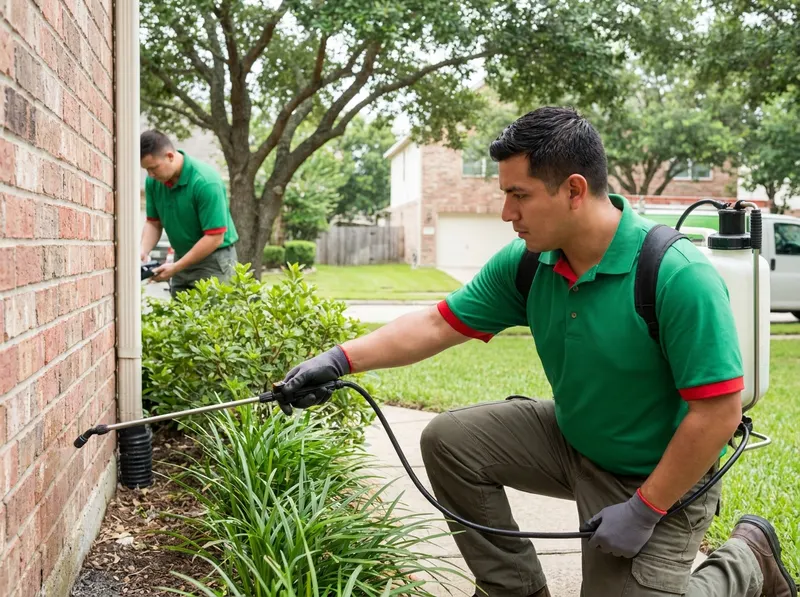
Sub-tropical humidity and alluvial soil systems across Harris County drive intense ant foraging pressures against slab foundations. Rather than using indoor broadcast repellents that scatter worker trails deeper into interior voids, perimeter defense treats the foundation as a biological containment boundary. Application involves a non-repellent liquid barrier formulated under EPA pesticide regulations applied 3 feet up the exterior brick, masonry, or siding and 5 feet outward into perimeter mulch, gravel, or soil. When workers cross this non-detectable zone, active ingredients adhere to their cuticles and transfer through the social matrix via trophallaxis, neutralizing subterranean queens without requiring interior fumigation. Specialized micro-dusting penetrates brick weep holes along slab foundations, compliant with structural protection guidelines established by the Texas Department of Agriculture to stop interior wall-void colonization.
Treatment selection depends on species biology and nesting behavior. If scouting trails consist of monogyne colonies nesting along perimeter concrete expansion joints, a direct dual-action non-repellent liquid application is the correct tactical fit. If properties face polygyne super-colonies of Tawny crazy ants or rover ants, frequently active along moist bayou corridors like Buffalo Bayou Park or heavily shaded lots in Memorial and Spring Branch, liquid bands alone prove insufficient; the required trade-off involves combining slow-acting macro-granular protein baits calibrated through research from the Texas A&M AgriLife Extension with specialized perimeter drenching. For large properties in Kingwood, The Woodlands, and Clear Lake with deep organic pine-needle duff, technicians execute systemic bait dispersal through perimeter beds to deplete external population pressure before structural contact occurs.
Historic pier-and-beam properties in Montrose, The Heights, and West University Place present unique physical vectors compared to modern slab-on-grade homes in River Oaks or Meyerland. Sub-floor crawlspaces demand targeted soil trenching along interior structural piers, paired with mechanical trimming recommendations governed by the International Society of Arboriculture to sever tree canopy bridges contacting fascia boards. Application schedules align with meteorological monitoring via the National Weather Service Houston/Galveston office to ensure liquid polymer bonds adhere to foundation surfaces during 4-to-6-hour curing windows without wash-off risks from localized gulf rainbursts. Water runoff parameters follow TCEQ water quality protective thresholds, preventing chemical migration into regional storm drains. All treatments adhere to chemical stewardship protocols established by the National Pesticide Information Center.
Every job gets a firm, written price after a free on-site visit.
For standards, safe disposal, and service guidance on pest control services in Houston, TX, useful references include U.S. EPA, ENERGY STAR, U.S. Dept. of Energy, Consumer.gov, U.S. Census Bureau, and Google Maps. General consumer and small-business resources are available from USA.gov, Better Business Bureau, FTC Consumer Advice, U.S. Small Business Administration, and Ready.gov.
Tell us about your perimeter ant defense job in Houston and we'll send a clear, written quote, usually the same day.
 TerraVance Bug Removal