Commercial kitchen vector control in Houston requires strict biological protocols to halt disease reservoirs where humidity, ambient grease, and sub-tropical temperatures accelerate reproduction cycles. In high-density…
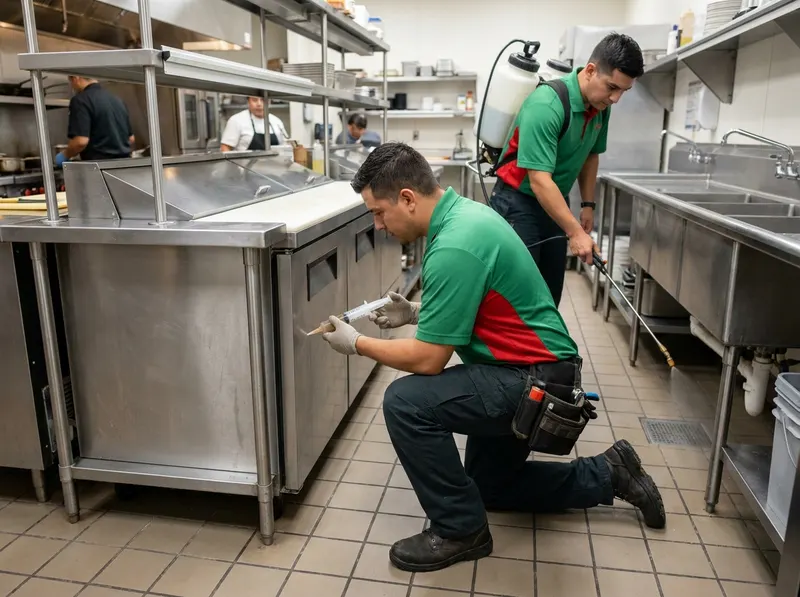
Commercial kitchen vector control in Houston requires strict biological protocols to halt disease reservoirs where humidity, ambient grease, and sub-tropical temperatures accelerate reproduction cycles. In high-density dining hubs like Montrose, The Heights, and the Houston Museum District, high-volume production lines generate localized moisture sinks under cooktops, dishwashing stations, and floor drains. These micro-habitats support explosive populations of German cockroaches, which carry pathogens such as Salmonella enterica across critical stainless steel staging areas. Rather than utilizing broadcast pesticide applications that risk surface contamination, technical intervention utilizes precision bait matrices and insect growth regulators to interrupt chitin development, neutralizing underlying harboring clusters behind stainless flashing and tile grout lines.
Drain ecosystems represent a secondary structural vulnerability in facilities throughout Downtown Houston, River Oaks, and West University Place. Floor drains accumulate organic fats, oils, and grease (FOG), generating anaerobic layers where scuttle flies and moth flies (Psychodidae) complete their larval life cycle in under 10 days. According to the FDA Food Code, structural harborage and insect activity on active prep lines mandate immediate remediation. Field technicians deploy enzymatic bioremediation foams that digest the organic substrate clinging to trap lines, paired with mechanical exclusion tactics defined under OSHA sanitation guidelines. This halts fly emergence without introducing volatile synthetic chemicals directly adjacent to operational walk-in coolers.
Rodent pressure increases significantly along bayou corridors near Buffalo Bayou Park and the Texas Medical Center, where sewer-dwelling Norway rats and tree-canopy roof rats seek kitchen warmth and pantry grains. Compliance with the Houston Health Department food ordinance requires documented, non-poisonous perimeter monitoring and physical vector exclusion around delivery loading docks, exhaust hoods, and plumbing penetrations. In outlying commercial hubs spanning The Woodlands, Kingwood, and Clear Lake, TerraVance Bug Removal secures structural thresholds against outdoor entry using copper mesh, silicone elastomeric sealants, and weighted sweep assemblies conforming to Texas Department of State Health Services retail food rules. Facility managers seeking immediate technical evaluation can contact TerraVance Bug Removal at (346) 210-5822 to schedule an on-site structural audit.
Every job gets a firm, written price after a free on-site visit.
For standards, safe disposal, and service guidance on pest control services in Houston, TX, useful references include U.S. EPA, ENERGY STAR, U.S. Dept. of Energy, Consumer.gov, U.S. Census Bureau, and Google Maps. General consumer and small-business resources are available from USA.gov, Better Business Bureau, FTC Consumer Advice, U.S. Small Business Administration, and Ready.gov.
Tell us about your commercial kitchen vector control job in Houston and we'll send a clear, written quote, usually the same day.
 TerraVance Bug Removal